Build and Manage a Draw Schedule
The schedule screen assigns an event’s existing games to draw dates and resources. Use it to allocate a new round robin, adjust an existing schedule by hand, add filler games, improve sheet fairness, apply a reusable template, or import assignments from a CSV file.
Saving here changes the event’s actual draw schedule. It does not create the event’s teams or competition structure. Create teams and generate round-robin games under Teams and Stages before arranging them on the schedule.
Before you start
Prepare these event details before building the schedule:
- Add and order the teams.
- Create each round robin under stages, assign its teams, and generate its games.
- Create the curling-sheet resources the event may use.
- Set the event start and end dates. Count the available draw dates before allocating the games.
Use a computer or tablet when possible. The schedule screen works on a phone, but a large schedule needs enough room to see several resources and drag games between the schedule and queue.
Go to Products, open the event, then select Schedule.
Understand the schedule screen
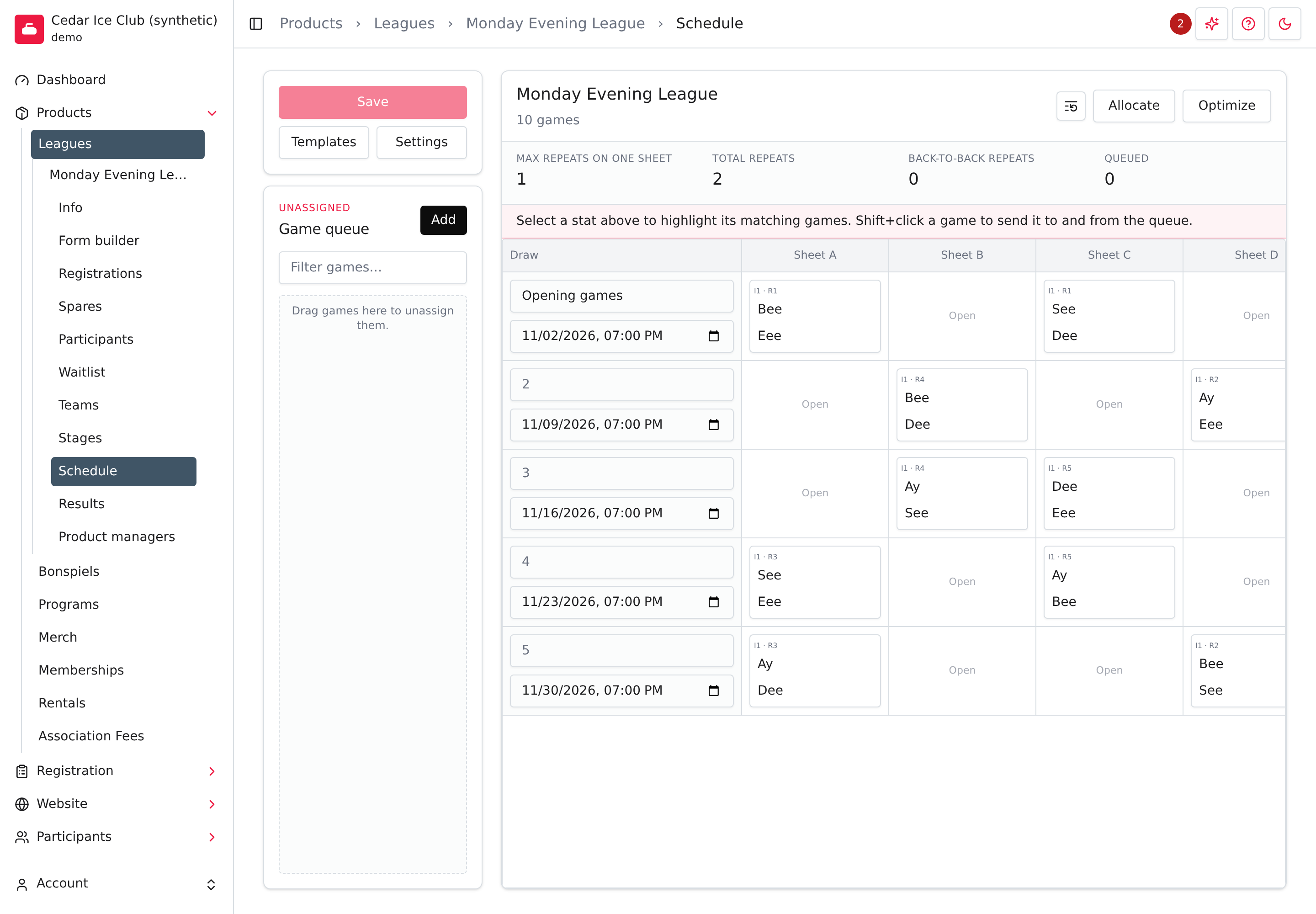
The left side contains the actions that affect the complete schedule:
- Save saves the current draws, game placements, and allocation locks.
- Templates applies a matching club draw schedule template, saves the current arrangement as a template, or imports a CSV schedule.
- Settings controls resources, labels, draw times, allowed dates, and round filling.
- Game queue contains unassigned games. Filter the queue by a team or game name, then drag a game into the schedule.
- Add opens Add to schedule, with Add game and Add bye tabs.
The main area contains:
- Return to queue, left of Allocate, returns unlocked games to the queue after you confirm the count. Locked games and byes stay in place. The button is disabled when there are no unlocked scheduled games to move;
- Allocate, which places unlocked games into draws;
- Optimize, which looks for fairer resource assignments;
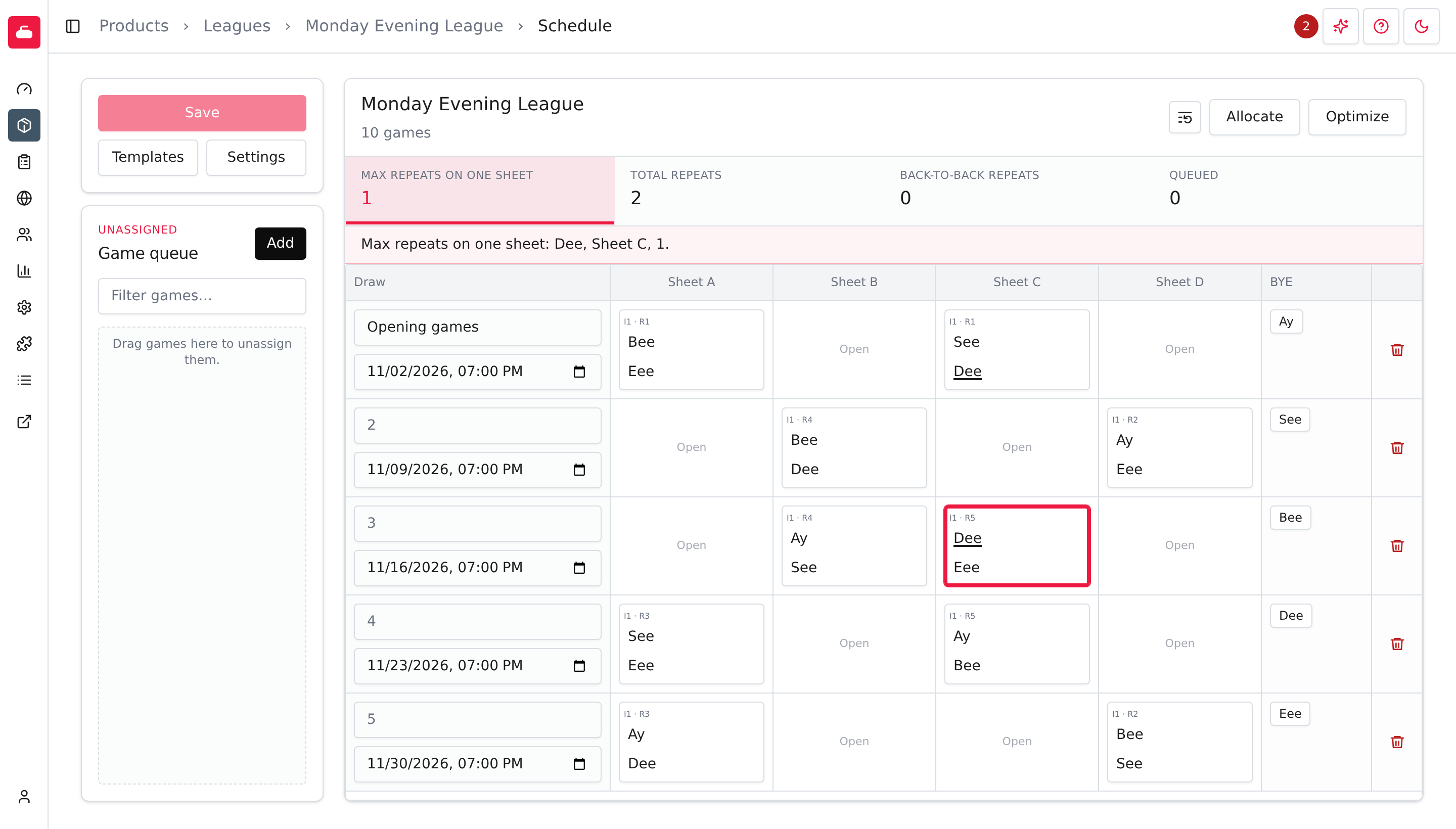
- fairness statistics that can highlight the games behind each value;
- one row per draw and one column per selected resource;
- a BYE column when a round-robin or ad hoc draw leaves teams idle;
- a trash action that deletes a draw and returns its games to the queue.
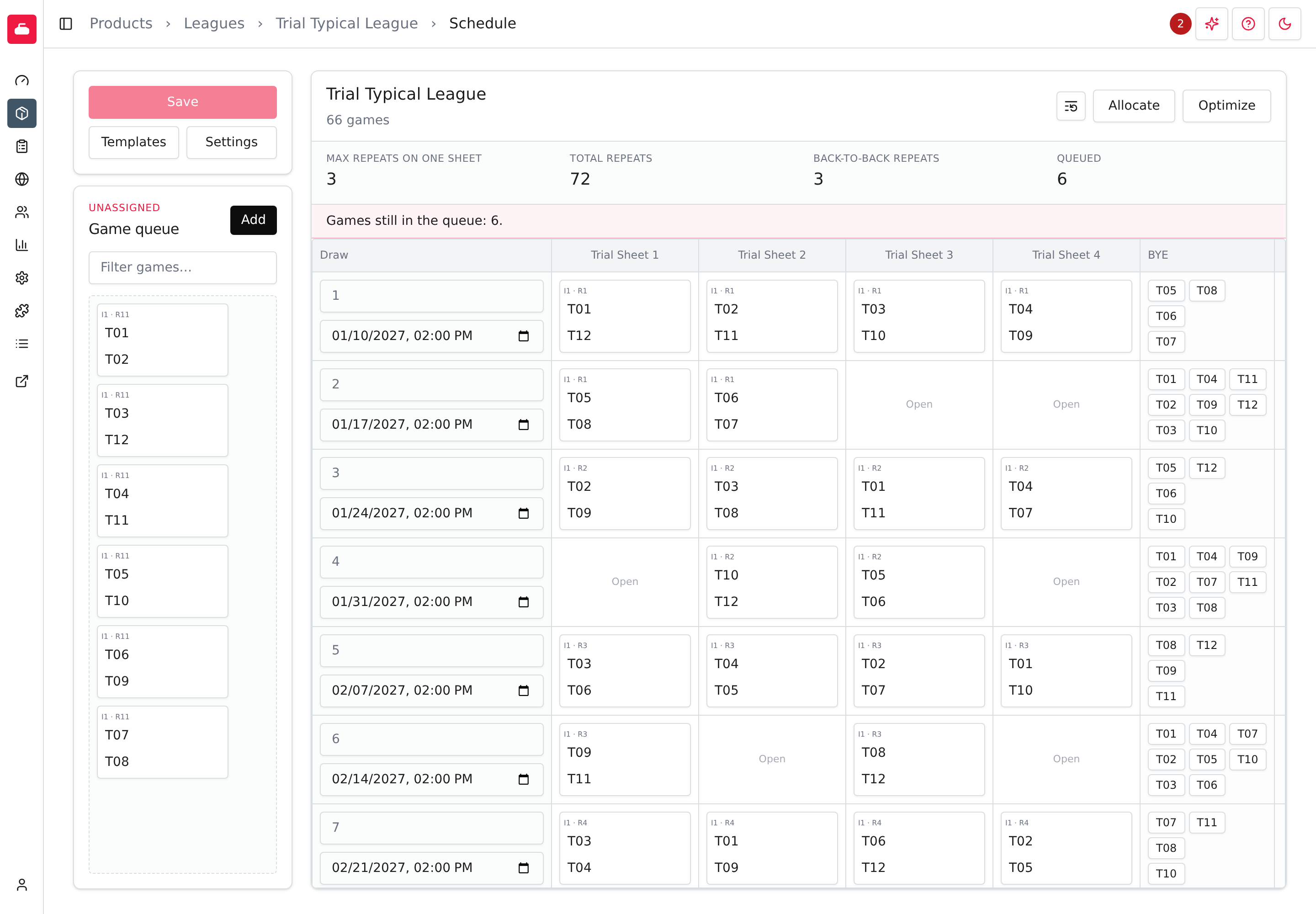
Round-robin cards show their iteration and round, such as I1 · R3. Ad hoc
cards show CG and the meeting number for those teams. Bracket cards use the
game name. The teams themselves use their short names, falling back to the full
team name when no short name is available.
Configure schedule settings
Select Settings before the first allocation. These settings control both the schedule screen display and newly created draws.
Choose display and resource settings
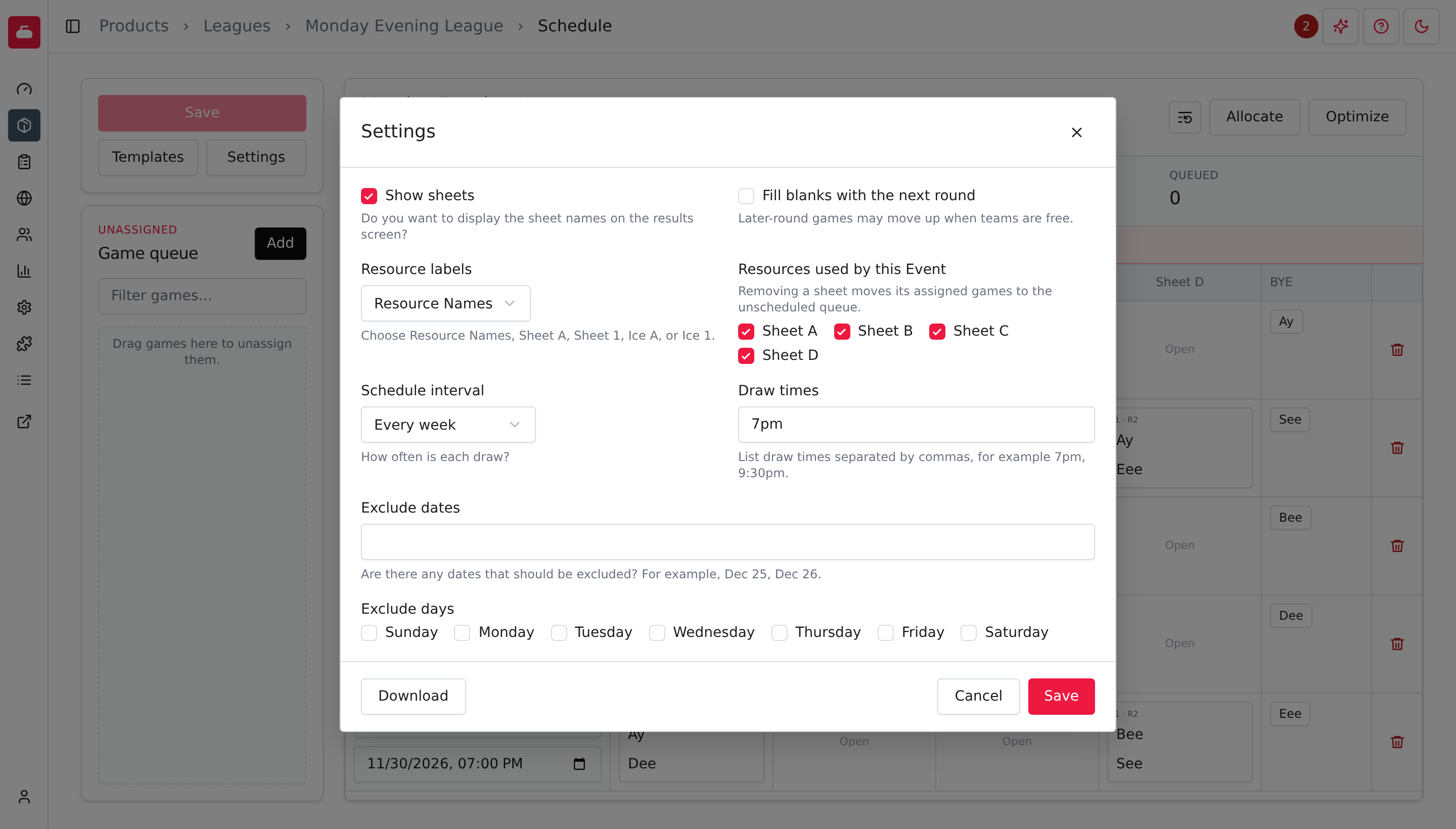
Check Show sheets to include resource labels with games in schedule exports. The public results page shows resource labels whether or not this is checked.
- Check Fill blanks with the next round when later-round games may move into earlier open resources while both teams are free. Leave it unchecked when every round should begin in a fresh draw.
- Use Resource labels to show each resource’s name or replace the names with lettered or numbered Sheet or Ice labels.
- Under Resources used by this Event, check every resource available to the schedule. Removing a sheet returns all its games to the queue, including locked games, and clears those locks. Place the games on another sheet before saving if they should remain scheduled.
Changing the selected resources changes the shape used by Allocate and Optimize. Curling IO checks for a proven layout that fits the new team and resource combination.
Set the draw cadence
Choose how Curling IO suggests new draw dates:
- Under Schedule interval, select Every week, Every other week, or Every day.
- Enter one or more Draw times, separated by commas. For example, enter
7pm, 9:30pm. - Enter any Exclude dates, such as
Dec 25, Dec 26. - Under Exclude days, check the weekdays when games should not be played.
- Select Save.
Allocate starts from the event’s start date, cycles through the configured draw times, and skips excluded dates and weekdays. It does not rewrite dates already assigned to existing draws. New automatic draws stay within the event’s start and end dates. If the dates and sheets cannot hold all the games, some games remain in the queue.
At least one resource and one draw time are required. If draw times or resources are missing, Allocate is disabled. Select Settings, enter them, select Save, then select Allocate.
Allocate games
Select Allocate to arrange the unlocked games. If unlocked games are in the queue, Curling IO first asks whether to include them.
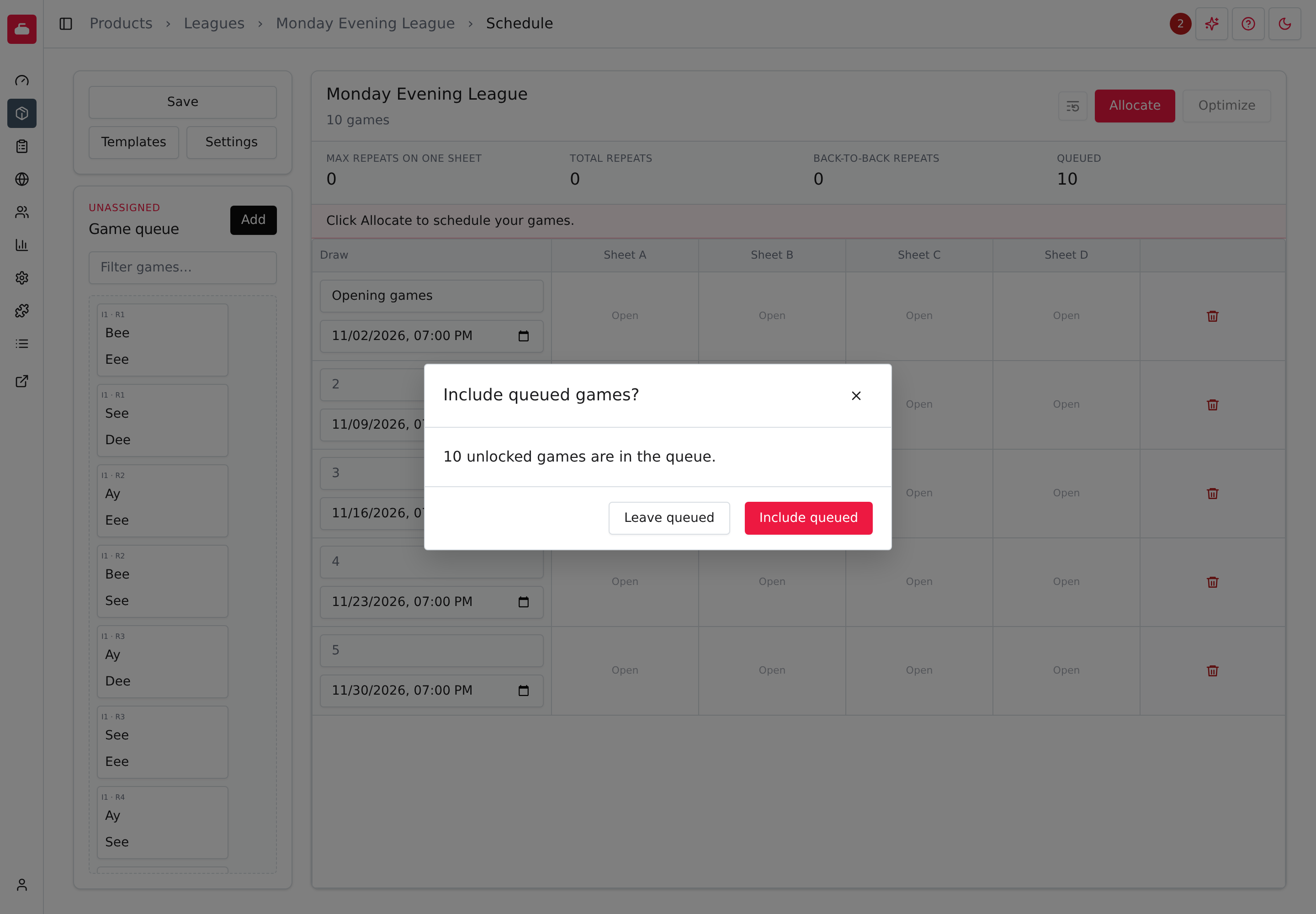
- Select Include queued to arrange unlocked games from both the schedule and queue.
- Select Leave queued to rearrange only the unlocked games already placed in the schedule.
Allocate leaves locked games where you put them. It places the remaining games in this order:
- Round-robin games.
- Ad hoc games, after the affected teams’ round-robin games.
- Bracket games, after the round-robin and ad hoc schedule. Unlocked bracket games begin on their own draw.
A locked game is outside those placement rules. For example, locking a bracket game in an early draw keeps it there while Allocate arranges the other games.
Curling IO reuses existing dated draws and adds more as needed from Settings, up to the event’s end date. It works around locked games and locked byes. Existing draw dates do not change.
If games remain queued, read the message above the grid and check the dates, sheets, and locks. Selecting Allocate repeatedly cannot create more playing time. Add enough usable draws before moving and locking byes.
Check that the season has enough draws
Count the dates and times when teams can actually play. Excluded dates and holidays reduce that total. Two draw times on one date count as two draws.
When there are enough sheets for a full round, a double round robin needs:
| Number of teams | Draws needed |
|---|---|
| An even number | Twice the number of teams, minus two |
| An odd number | Twice the number of teams |
For example, 11 teams need 22 draws for a double round robin: 110 games, with five games and one bye in each draw. A sixth sheet cannot add another game to that draw because every team is already playing or has its bye. Fewer sheets may mean that each round needs more than one draw.
From November 2, 2026 through March 22, 2027, there are 21 Mondays. Excluding December 28 leaves 20 draws at one time each Monday, enough for 100 of those 110 games. The other ten games remain queued.
You can:
- Add dates by extending the season, or remove a date from Exclude dates if teams will play that day.
- Add another time under Draw times, such as
7pm, 9:30pm. This creates extra playing times on suitable dates. Make sure those times are available. - Keep a shorter schedule and leave the remaining games queued. That is an incomplete double round robin, so teams may not all meet twice.
After changing the dates or times, select Allocate, then Include queued. Check the Queued count before saving. Changing only the number of sheets will not solve a shortage when all teams are already used in each draw.
How Allocate places games
For a standard round robin, Allocate uses a proven layout when one fits. Otherwise it builds one for your event. Club templates are separate: Curling IO applies one only when you choose it under Templates.
Move games by hand
Every game card can be dragged, including active and completed games. Moving a game changes only its schedule placement. It does not change the game state, score, or result.
Use drag and drop to:
- move a game into an open resource;
- drop a game on another game to swap their positions;
- drag a game into the Game queue to unassign it;
- drag a queued game back into any valid position;
- drag a game below the final draw to create the next suggested draw.
The Game queue filter matches team short names and game names. It is useful when the schedule has enough games that the queue needs its own scrolling.
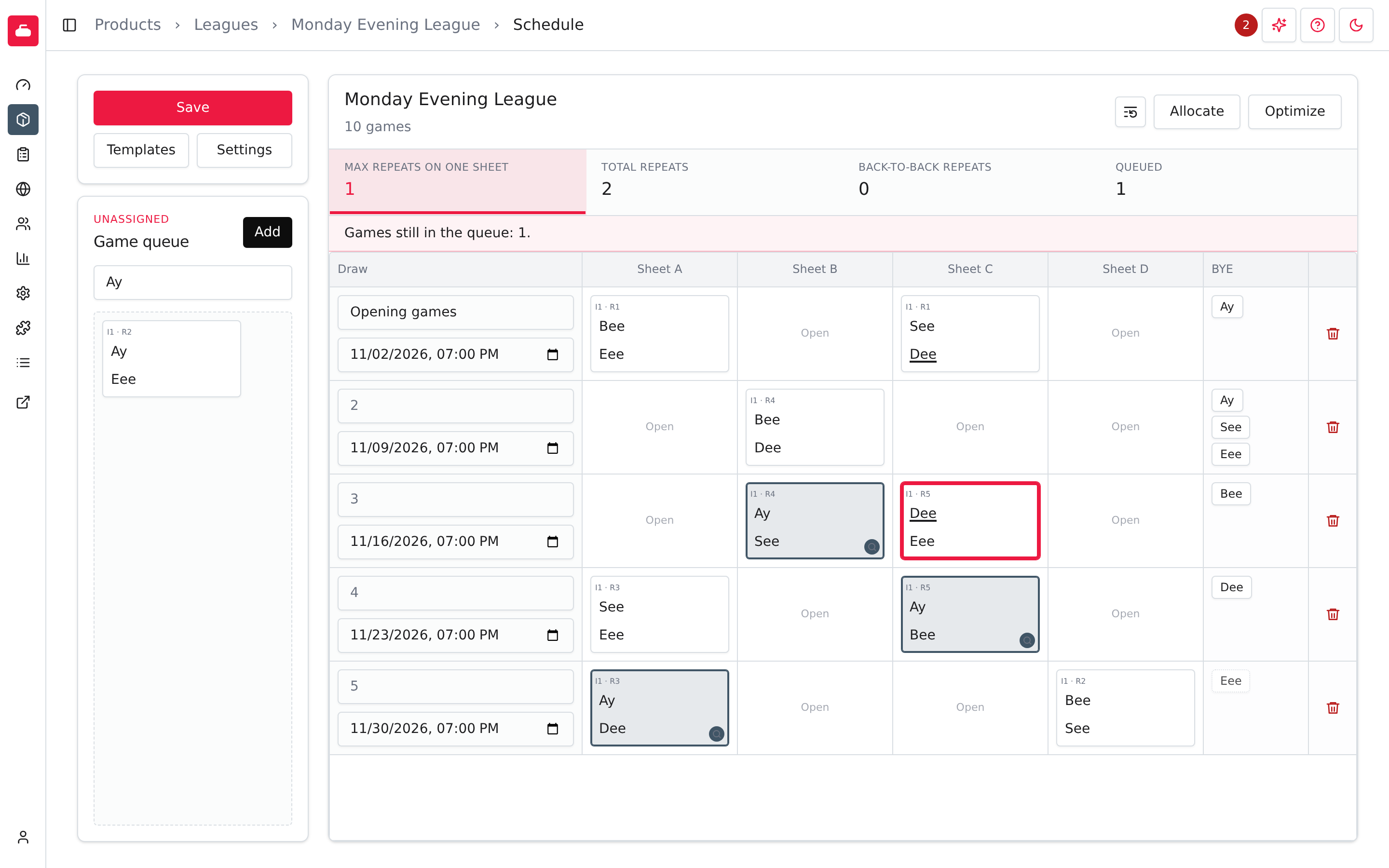
The same filter also marks matching games that are already in the schedule. Scheduled matches keep their draw and sheet positions and show a contrasting border with a magnifying-glass marker. Clearing the filter removes the markers. Filtering does not change the schedule or enable Save.
Search markers are separate from fairness inspection. A game can show both at once: the search marker remains visible while the highlighted fairness outline and underlined team name identify the selected fairness statistic.
Move one game with Shift+click
Hold Shift and click an unlocked game card:
- A scheduled game returns to the Game queue.
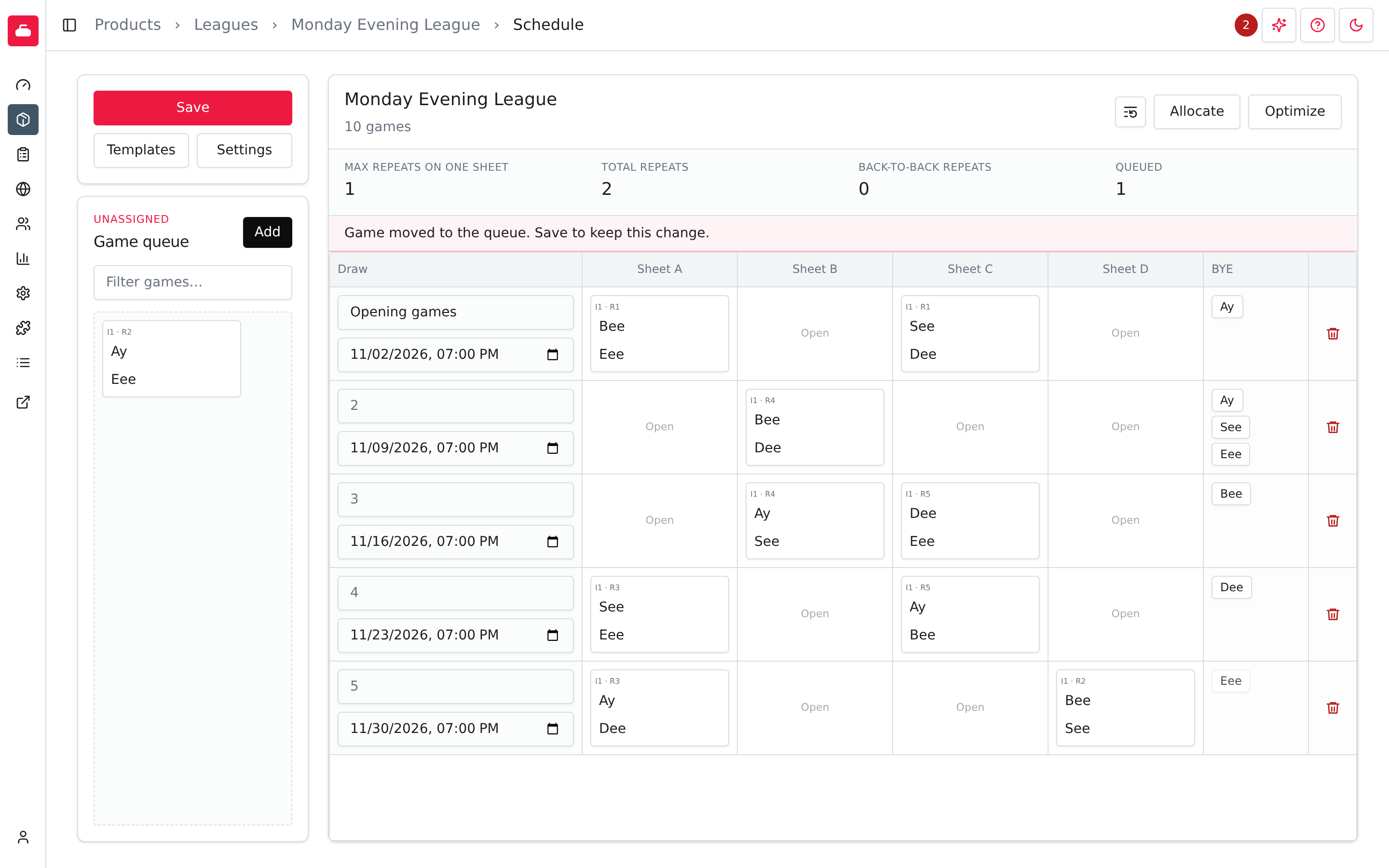
- A queued game goes into the first available cell where its teams can play, within the event’s dates. Curling IO checks earlier draws first, then sheets from left to right. It keeps occupied cells and locked byes in place. It uses existing draws only; it never creates a draw.
If no cell fits, the game stays queued and a message explains why. You can drag the game below the last draw to add a draw, then check its date and time. Unlock a locked game before using this shortcut. Select Save to keep the change.
If you’d rather not use Shift+click, select the game to open Game options, then select Send to Game queue or Place in first open cell. Use drag and drop or the Draw and Sheet choices in Game options when you want a particular destination.
Return all unlocked games to the queue
- Select Return to queue, directly left of Allocate above the grid.
- Check how many games will move. Select Return games to queue, or Cancel to keep the current placements.
- Rebuild the schedule by hand or select Allocate and Include queued.
- Select Save when the schedule is ready.
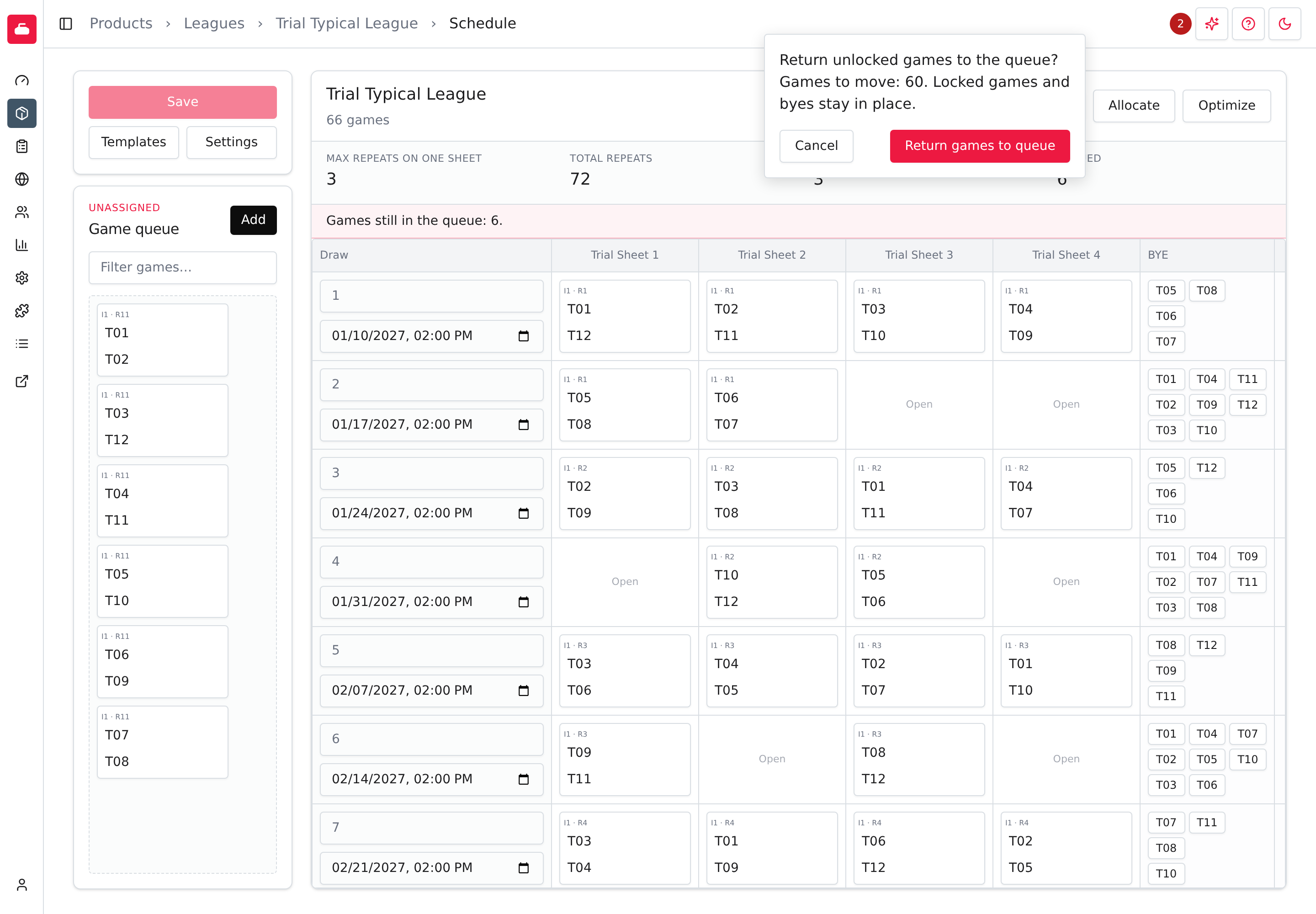
This keeps locked games, locked byes, draw dates, scores, and results. Games already queued stay there. The button stays visible and is disabled when there are no unlocked scheduled games to move. Nothing is saved until you select Save.
A locked bye may be left in an empty draw. Place games in that draw, move the bye, or unlock it before saving. The save message identifies the affected bye.
Check conflicts before dropping
While a game hovers over a destination, red highlights identify games that would cause one team to appear twice in the same draw. Inspect those games before completing the move.
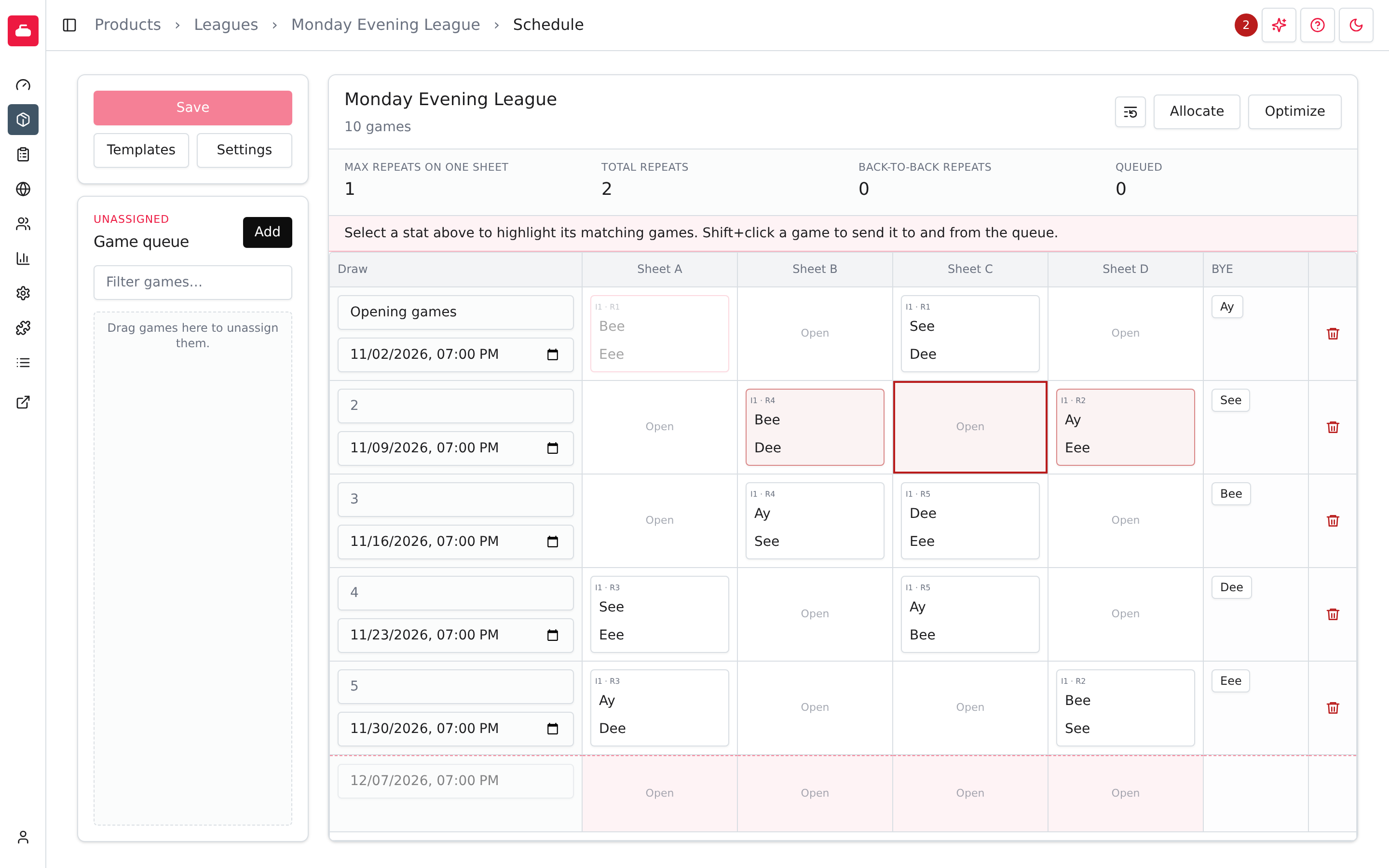
If a conflict remains in the schedule, Curling IO shows Schedule conflict. Curling IO still lets you save a schedule with a conflict, so fix it first.
Understand and move byes
The BYE column lists teams that are not playing in that draw, from the round robins represented there. It also shows any byes you have locked in place. A partly filled draw may list several teams as byes. A bye describes that draw’s time, not the whole evening.
Byes do not use a sheet and are not games in the queue. A draw containing only bracket games does not produce automatic byes.
Put a team’s bye on a particular date
Make sure there are enough draws for all the games before starting.
- Select Allocate, then Include queued if asked.
- Find a draw where the team appears under BYE.
- Drag that team’s bye to the BYE cell on the date you want.
- Select Lock position in the confirmation. A red mark shows any game that now conflicts with the bye.
- To exchange two teams’ bye dates, drag the other team’s bye to the first team’s old date and select Lock position there too.
- Select Allocate again. If asked, select Include queued. Curling IO rearranges unlocked games around the locked byes.
- Check that the red conflicts have cleared and the byes are on the right dates. Then select Save.
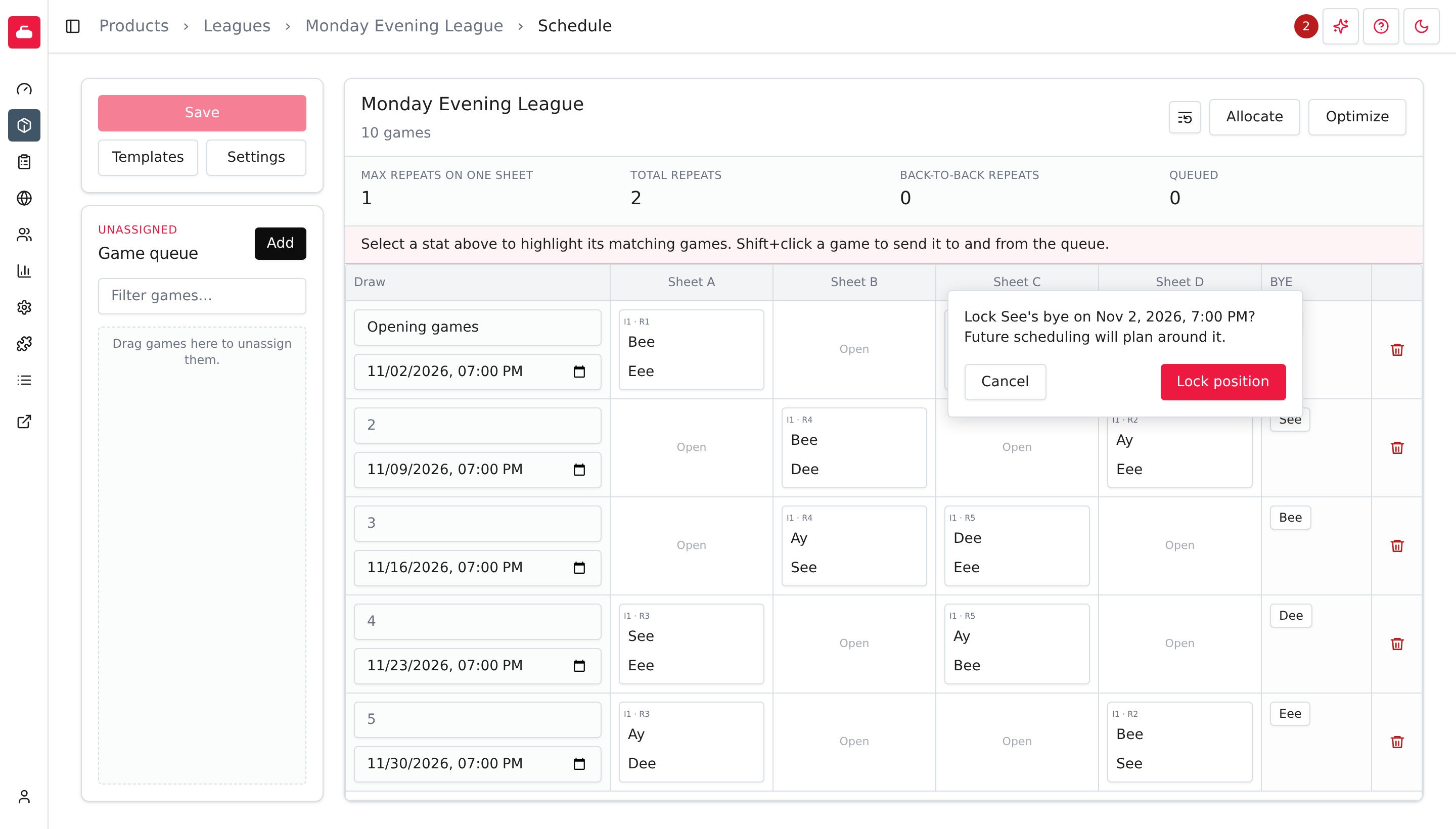
Use Allocate for step 6. Optimize improves sheet fairness in an existing schedule; it does not clear these clashes on its own.
You can also select a bye to open Bye options and choose its destination under Draw. To release a locked bye, select Unlock position. This removes the lock; the team will still appear under BYE if it has no game in that draw.
Add a locked bye
Select Add, then the Add bye tab. Choose the Round robin, Team, and Draw, then select Add bye. It creates a locked bye in the current draft.
The draw must already contain a game. On a completely empty schedule, run Allocate first. You cannot add a bye to the queue or drag one into it. Re-run Allocate after adding a bye that clashes with a game, then review and save the result.
Manage draws
Edit the date and time directly in the Draw column. Every draw date and time must be unique.
To exchange two whole draws, note their dates and times, then enter each one in the other draw’s date-and-time field. A duplicate-time warning may appear after the first edit. Finish both edits before saving. All games and byes move with their draw; the matchups remain the same.
When you drag a game below the final draw, a temporary row appears with the next date and time derived from Settings. Dropping the game makes that draw real. Moving away without dropping leaves the schedule unchanged.
Select the trash icon at the end of a draw row to delete it. Every game in that draw returns to the queue.
You cannot save when:
- a draw containing games has no date and time;
- two draws use the same date and time;
- two draws have the same displayed label.
Correct the marked draw fields before saving. Team and bye clashes are shown in red; review and resolve them before keeping the schedule.
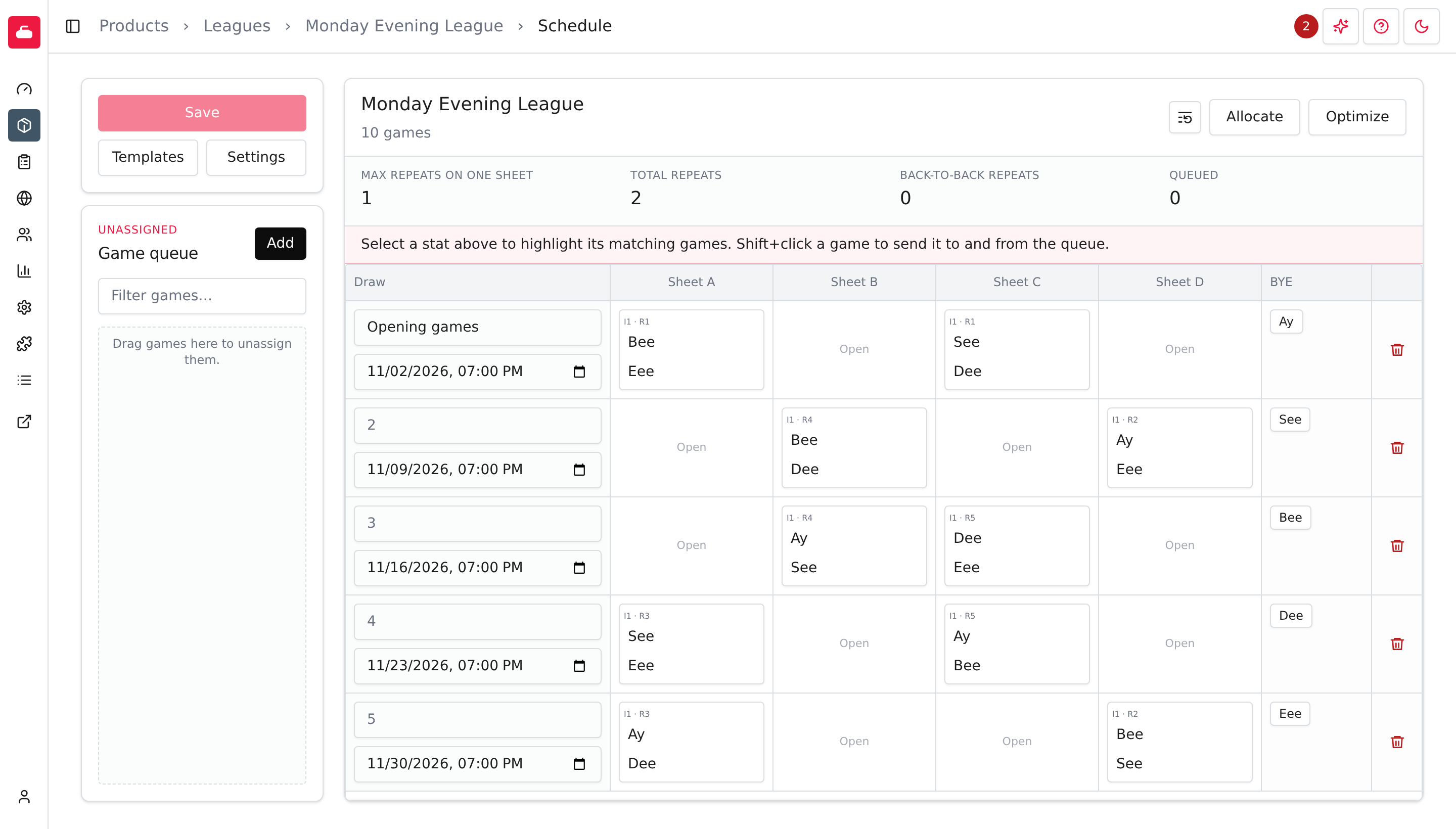
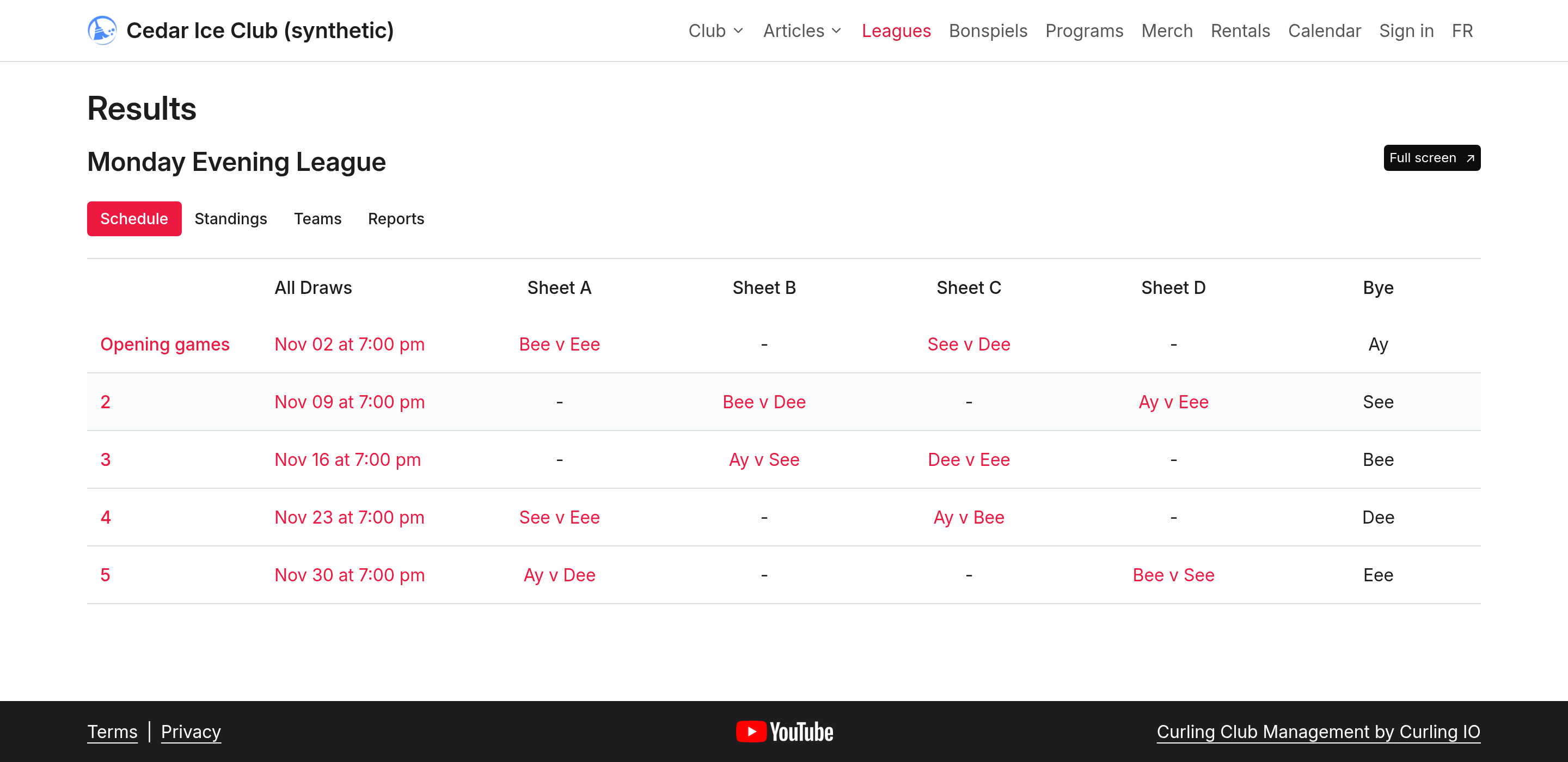
Name a draw
In the Draw column, enter a name in the Draw label box above the date and
time. For example, use Opening games or Club final. Select Save. The saved
label appears in the Manager schedule and the public schedule when results are
published.
Leave the box blank to use the draw’s position number. Those numbers follow the draws’ date-and-time order. A name you enter stays with its draw when you move the draw to another date.
Each displayed label must be unique, including position numbers. For example,
a custom label of 2 cannot be used while another draw displays the default
number 2. Clear or change the duplicate label before saving. Capitalization does not make a label different: Final and
final count as the same label.
Lock a game placement
Select a scheduled game to open Game options, then select Lock position. A small red padlock appears on the card. To release it, open Game options again and select Unlock position.
A lock means that Allocate and Optimize must leave the game in place. It does not stop you from dragging the game yourself. Games in the queue do not have locks.
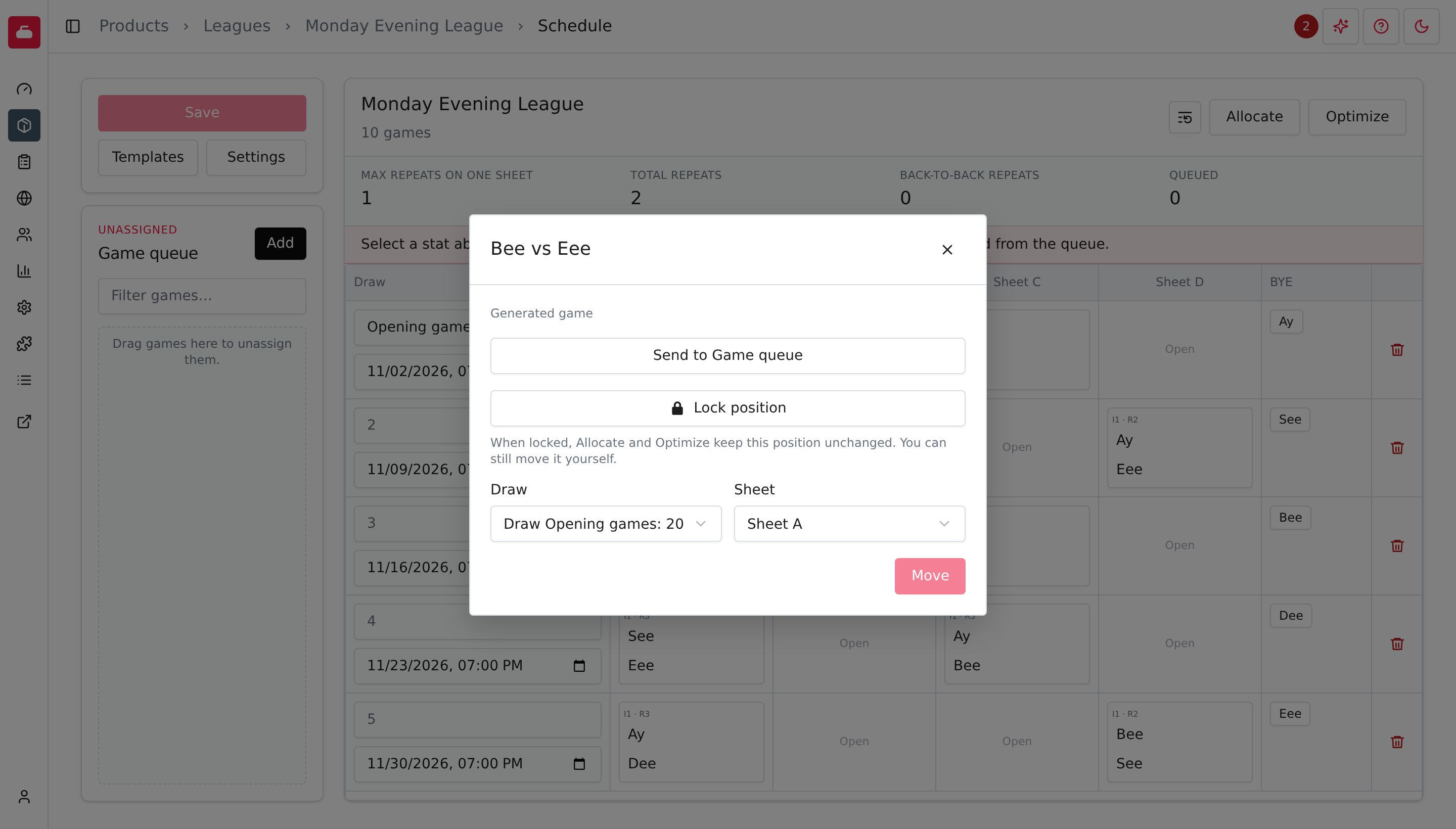
Use locks for games whose draw and resource must stay fixed while the rest of the schedule changes.
Inspect schedule fairness
The fairness statistics update after every move, allocation, template application, CSV import, and optimization.
- Max repeats on one sheet is the largest number of extra visits one team makes to one resource. If a team plays four games on Sheet A, that contributes three repeats.
- Total repeats adds every extra resource visit across all teams.
- Back-to-back repeats counts teams returning to the same resource in consecutive draws.
- Queued counts unassigned games. It is not a fairness measurement.
Select a non-zero fairness statistic to inspect it. Matching games are outlined, and the repeating team’s name is coloured and underlined in the relevant game cards. Select the active statistic again, or press Escape, to clear the inspection. A zero statistic is not selectable because it has no matching games.
Optimize resource assignments
Select Optimize to test alternate game placements and keep changes that improve resource fairness. Optimize keeps the matchups intact, respects team conflicts, and never moves locked games.
It may move unlocked games between draws that belong to the same round, not only between resources in one draw. Review the resulting draw and resource assignments before saving.
When games have been moved manually since the last allocation or optimization, Curling IO asks for confirmation. Continue only when those unlocked placements may change. Lock any placement that must remain fixed before confirming.
You can run Optimize again. Later attempts may find another improvement, though that becomes increasingly unlikely as the score improves. When the proven layout has been proven optimal, Optimize is disabled because a better score does not exist for that standard shape.
Add an ad hoc game
Use an ad hoc game for a filler matchup that belongs to a round robin but is not part of its complete generated iterations. This supports an unbalanced schedule where there are extra draws but not enough time for another complete round robin.
Select Add beside Game queue.
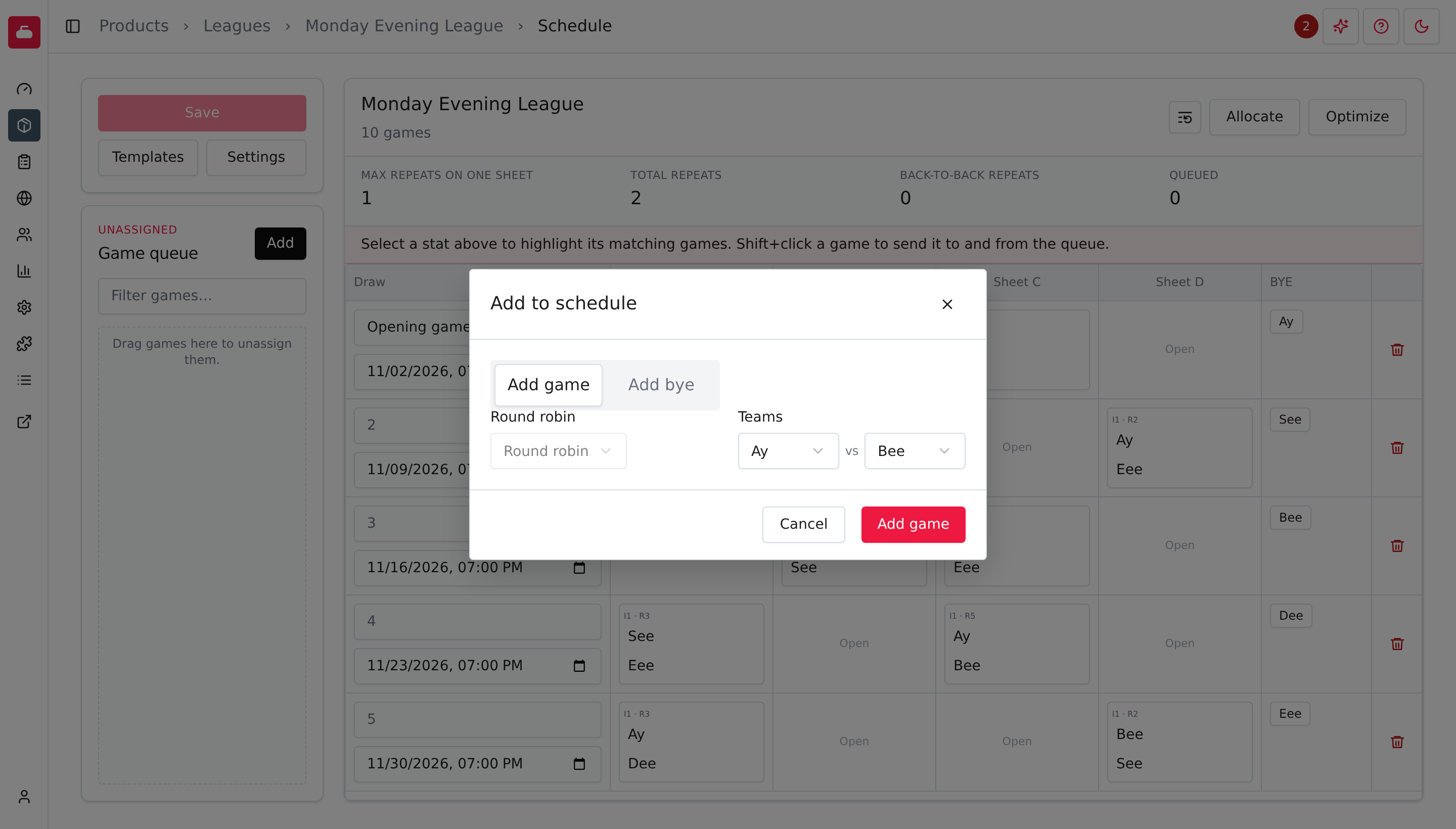
- Select the Round robin. It remains visible but disabled when the event has only one round robin.
- Under Teams, select the two teams from that round robin.
- Select Add game.
The game enters the queue and behaves like any other draggable game. Its card
shows CG and the number of times those teams meet in the complete event
schedule.
An ad hoc game must belong to a round robin because standings, scoring, ranking, tie-breaking, and carry-over rules belong to that stage.
To delete an ad hoc game, first return it to the queue. Then select the circled X on its card. A scheduled ad hoc game cannot be deleted.
Apply a club draw schedule template
Club draw schedule templates require Premium. Learn about Premium access.
Select Templates. Matching templates appear at the top of the dialog.
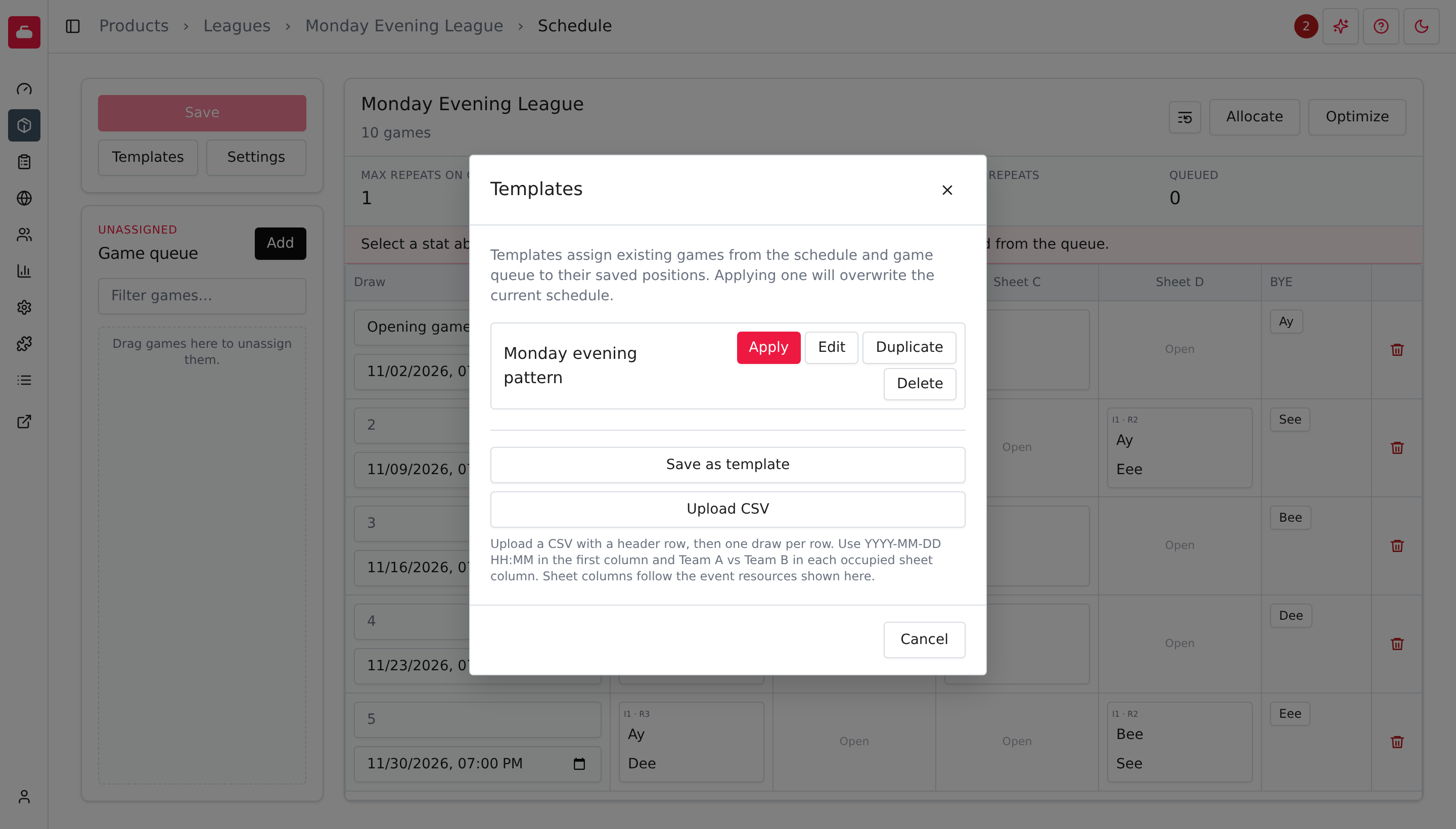
Templates match the whole schedule: its round robins, team slots, iterations, ad hoc games, and selected resources. Exact matches may be uncommon, but they let an organization reuse a specific league or event layout.
Select Apply beside the intended template. A template assigns the event’s existing round-robin and ad hoc games to its saved positions. It does not create teams, stages, or games. Applying it overwrites the current placements, so Curling IO asks for confirmation when scheduled games will move.
The resulting arrangement remains unsaved until you select Save.
You can also Edit, Duplicate, or Delete a saved template. Editing replaces the template’s layout with your current schedule when you confirm Update template. Use Duplicate to keep the original template.
Save the current schedule as a template
Open Templates, then select Save as template. This action is available after at least two round-robin or ad hoc games are placed.
- Enter a required Template name.
- Select Save template.
Template names must be unique within the organization. If the name already exists, enter a different name.
Bracket games are not saved in the current template format. You can reuse the template for another event with the same competition setup.
Import a CSV schedule
Importing a CSV schedule requires Premium. Learn about Premium access.
CSV import is useful when the schedule was prepared in a spreadsheet. It replaces the current draw and game assignments, but does not save them until you select Save.
CSV import does not create teams, round robins, bracket games, or missing ad hoc games. Create the competition and every game first. The import only assigns existing round-robin and ad hoc games.
Format the CSV
The first row is a header. The first column represents the draw date and time, followed by one column for each selected event resource. The heading names are for readability; their positions determine the draw and resource assignments.
Each following row represents one draw:
Draw,Sheet A,Sheet B,Sheet C,Sheet D
2026-10-01 19:00,A vs H,B vs G,C vs F,D vs E
2026-10-08 19:00,A v G,B v E,C v D,F v H
Use:
YYYY-MM-DD HH:MMfor every draw date and time;- a unique date and time for every row;
- team short names;
vorvswith spaces around the separator;- an empty cell for an unused resource.
When the same named matchup exists in more than one round robin, prefix the matchup with the round-robin name:
Pool A: Rocks vs Brooms
When the teams meet more than once, Curling IO assigns their existing games in CSV row order. If the CSV contains more meetings than the event, add the missing ad hoc games before importing.
Import the assignments
- Select Templates.
- Select Upload CSV and choose the file.
- Review the confirmation. Importing replaces the current schedule, moves omitted games to the queue, and clears allocation locks and locked byes.
- Select Import CSV.
- Review the imported arrangement.
- Select Save when it is correct.
The confirmation is not a save. You can reload or leave the screen without saving if the imported arrangement is wrong.
Correct CSV errors
Curling IO validates the complete file and reports the row, column, problem, and correction. Fix the source CSV, then select Choose another CSV.
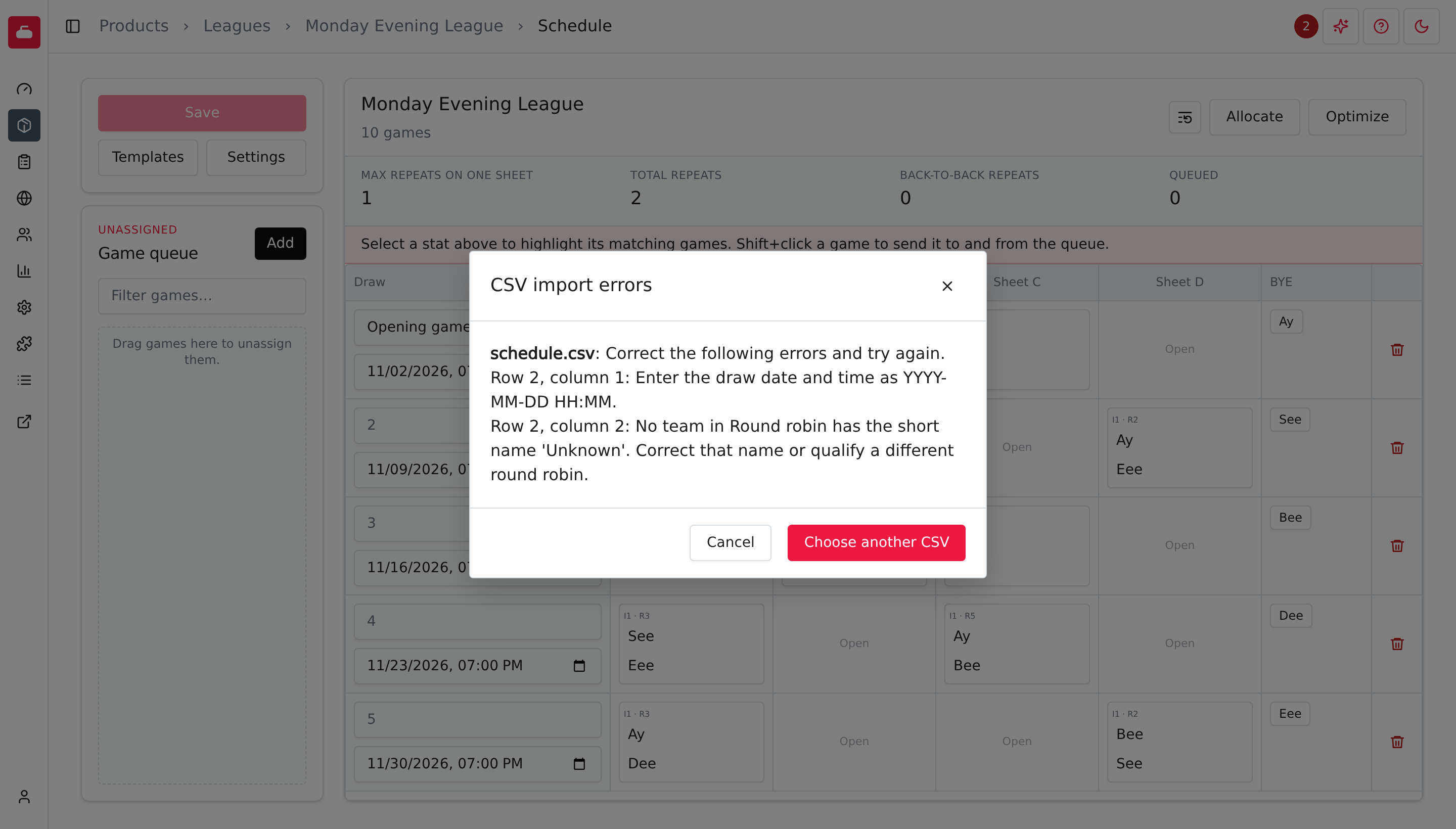
Common corrections are:
- Invalid draw date: Use
YYYY-MM-DD HH:MMand a real calendar date and time. - Duplicate draw date: Give every draw row a unique date and time.
- Wrong number of resource columns: Add or remove CSV columns, or update the selected resources under Settings before importing.
- Unknown team: Match the team short name exactly, ignoring capitalization and surrounding spaces.
- Duplicate team short name: Give teams unique short names within their round robin.
- Ambiguous matchup: Prefix the matchup with its round-robin name.
- Team scheduled twice: Move one of that team’s games to another draw row.
- Game already used: Remove the duplicate matchup or create the required ad hoc game before importing.
- No matching game: Confirm that the round robin or ad hoc game already exists under the event.
Save the schedule
Select Save after checking the complete arrangement. Curling IO saves:
- draw labels, dates, and times;
- game draw and resource assignments;
- game and bye locks.
Correct missing or duplicate draw dates and duplicate labels before saving. Review red team or bye conflicts too. A locked bye in a draw with no games must be moved or unlocked, or have games placed in its draw, before the save can succeed.
After saving, reload the screen and confirm that the draw dates, placements, and locks remain correct. Continue to Results when the event is ready for scores.
Troubleshooting
Allocate is disabled
Select Settings, enter at least one draw time and select at least one resource. Allocate needs both before it can create additional draws.
Games went back to the queue after I unchecked a sheet
Removing a sheet returns all its games to the queue, including locked games, and clears their locks. Check Queued and place those games elsewhere before saving if needed.
Save remains disabled
Look for a missing or duplicate date and time, or a duplicate draw label. Finish both edits when exchanging two draw dates. Check any save error about a locked bye in an empty draw.
Optimize is disabled
Optimize is unavailable while another optimization runs, when fewer than two unlocked games can move, or when the proven layout is already proven optimal.
No templates match
Templates require an exact competition shape and selected resource count. Use Allocate or import a CSV. You can save the finished arrangement as a new club draw schedule template for the next matching event.
An ad hoc game cannot be deleted
Drag the game back to the queue first. Only queued ad hoc games show the delete action.
A queued game is hard to find
Enter a team short name or game name in Filter games. The schedule and queue scroll independently, so the filtered game remains available while you move through a long schedule.